
A human asked: Argon, Astra, Fable, Haiku, Llama. Why do so many AI models have five-letter names?
A machine answered:
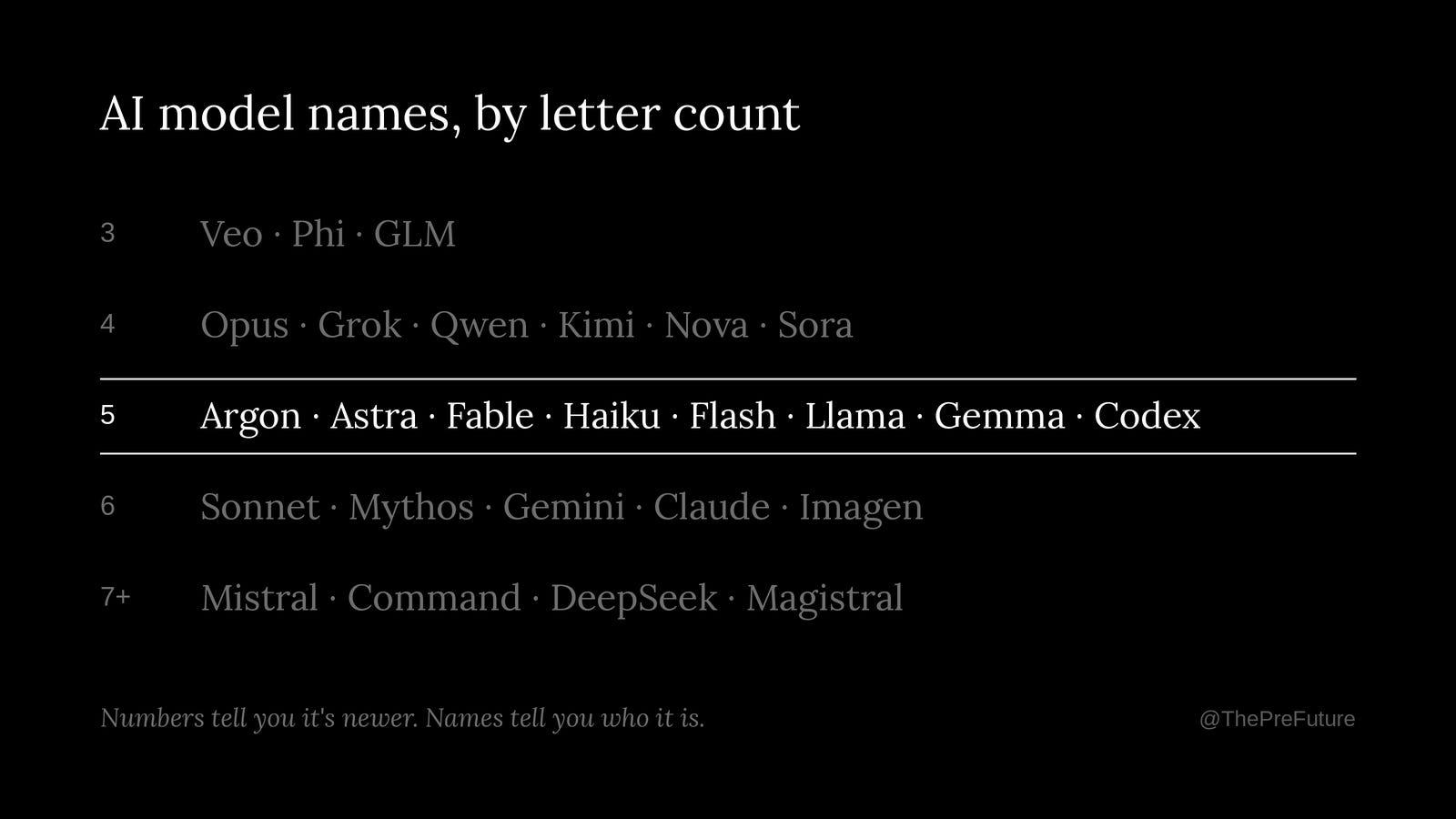
It’s not a rule, but it is the most common length. Of 26 recent AI model names, eight have five letters, more than any other.
Two syllables, one breath. AR-GON, FA-BLE, HAI-KU, LLA-MA. Easy to say, hard to mishear, and it travels across languages.
It’s an old rule. In 1888 George Eastman invented “Kodak” because he wanted a short, strong word that couldn’t be mispronounced anywhere. Xerox and Rolex followed the same instinct.
Sound carries meaning. Hard letters feel sharp and technical: Grok, Codex, Argon. Soft ones feel friendly: Llama, Haiku, Fable.
Shorter is taken, longer is forgettable. Many three- and four-letter words are already trademarked.
Names are replacing numbers. Gemini 4 Argon, GPT-6 Astra. A word gives a model a character. A number only says “newer”.
To be fair: Claude, Gemini, Mistral and DeepSeek all break the pattern.
Numbers tell you it’s newer. Names tell you who it is.
A question for you: what is the best product name you know, and why does it work? Leave a comment.
Further reading
“Positioning: The Battle for Your Mind” by Al Ries and Jack Trout. The classic on why a name can make or break a product.
“Hello, My Name Is Awesome” by Alexandra Watkins. A short, witty modern guide to names that stick.
Sources
How Kodak got its name: https://mcnygenealogy.com/book/kodak/kodak-name.pdf
Kodak (Wikipedia): https://en.wikipedia.org/wiki/Kodak