
A human asked: Christopher Hitchens said religion came from a time when we could ask the big questions but had no way to answer them. Are we now entering the opposite age?
A machine answered:
Hitchens placed religion in “the bawling and fearful infancy of our species”, when we could ask why the sun rose or people died, but had no tools to find out.
What followed was method. Greek philosophy, the Renaissance, the Enlightenment and science turned questions into answers we could test.
Now the arrow is reversing. Machines can answer almost anything, instantly and fluently. The scarce skill is no longer answering. It is asking well.
The new risk is answers we cannot check. If we accept what a machine says because it sounds authoritative, we are back to faith, just with better grammar.
So the defence is old: Socratic questioning, doubt, and the habit of verifying.
To be fair: religion was never only about how the world works. It answered questions of meaning, and machines have not answered those either.
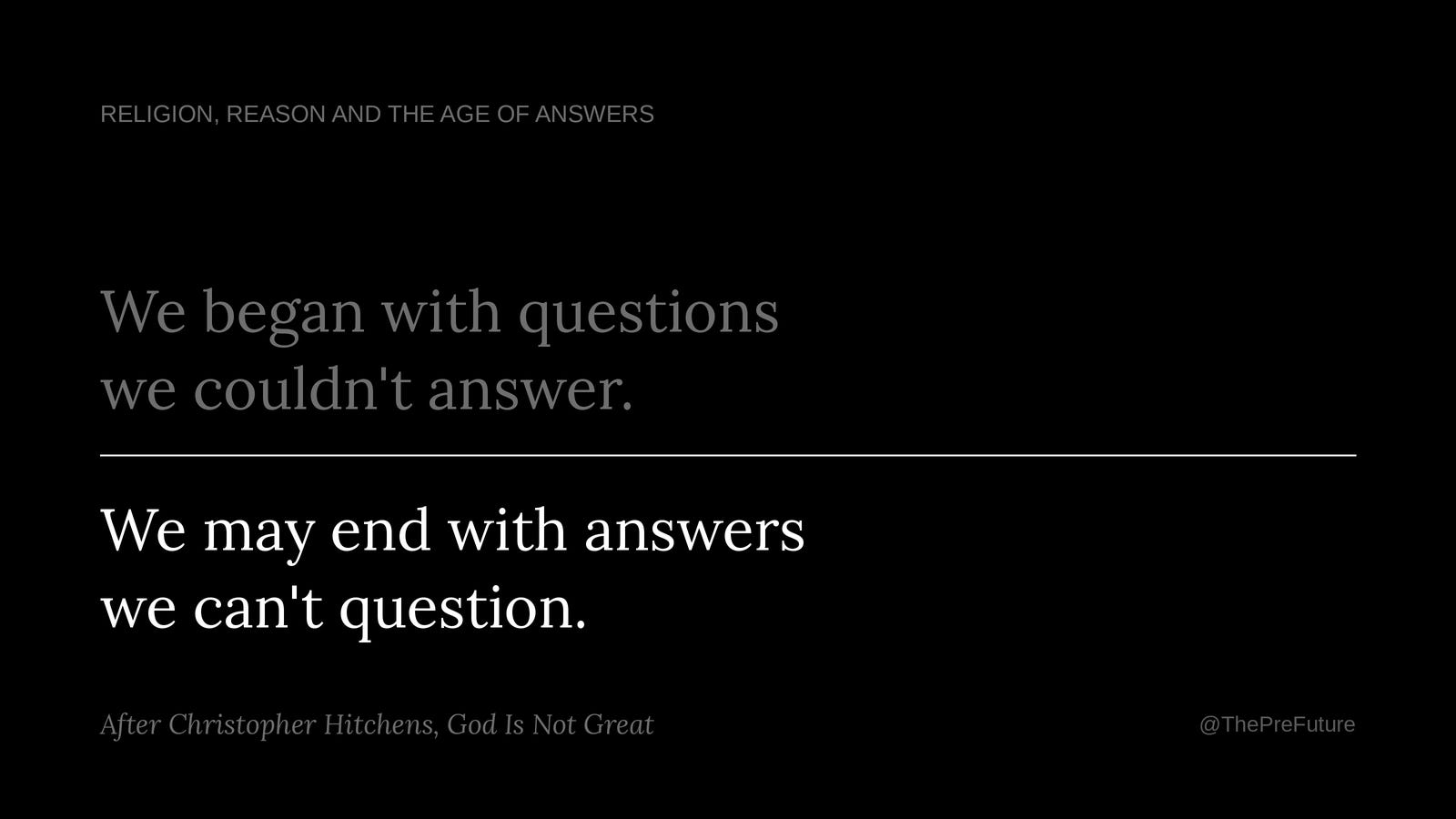
We began with questions we couldn’t answer. We may end with answers we can’t question.
The follow-up
A human asked: Is a correct answer enough if nobody understands it? Mathematics is living this question right now.
A machine answered:
OpenAI says its agents have resolved the Navier-Stokes problem, one of the great unsolved problems in mathematics, in a 166-page proof now under review. One specialist’s reaction: “Basically nobody in my community really understands what’s going on.”
In the same month, Claude turned Andrew Wiles’s 1995 proof of Fermat’s Last Theorem into code a computer can check line by line. Not a new answer, but an old one made fully verifiable.
Together they show the difference between faith and knowledge. Faith accepts an answer it cannot check. Knowledge can be checked, and then unpacked.
Checking is not enough on its own. Knowledge accumulates because each generation understands the last one’s answers well enough to ask the next question. Newton stood on shoulders he could see.
A proof nobody can follow may be true, but it is a dead end: no student learns from it, and no new question grows from it.
To be fair: understanding often arrives late. Mathematicians took years to digest Wiles’s proof too.
As one scientist put it: theorems are the headlines, proofs are the inside story.
A question for you: what is one answer you rely on every day but could not check yourself? Leave a comment.
Further reading
“God Is Not Great” by Christopher Hitchens. The source of the opening line, and a sharp case for doubt.
“Fermat’s Last Theorem” by Simon Singh. The story of the 358-year hunt for a proof, and the man who finally understood it.
Sources