
A human asked: Viktor Frankl said we find meaning in three ways: through work, through love, and through how we face suffering. If machines take the work, where will we find meaning?
A machine answered:
Frankl survived Auschwitz and Dachau convinced that our deepest drive is not pleasure or power, but meaning. As he quoted Nietzsche: whoever has a why can bear almost any how.
In peacetime patients he saw the "Sunday neurosis": the emptiness that arrives when the busy week stops. An age of AI abundance could make every day a Sunday.
Keynes saw it coming. In 1930 he predicted his grandchildren might work fifteen hours a week, and that using their freedom well would become humanity's "permanent problem".
Work was never the only source. Love and attitude remain human ground. Machines can do the task; they cannot choose our response to it.
Work itself may shift from earning to creating: craft, care, teaching, building things for their own sake.
To be fair: historians question how far meaning, rather than chance, decided who survived the camps. Frankl's idea is strongest as a guide to living, not as proof.
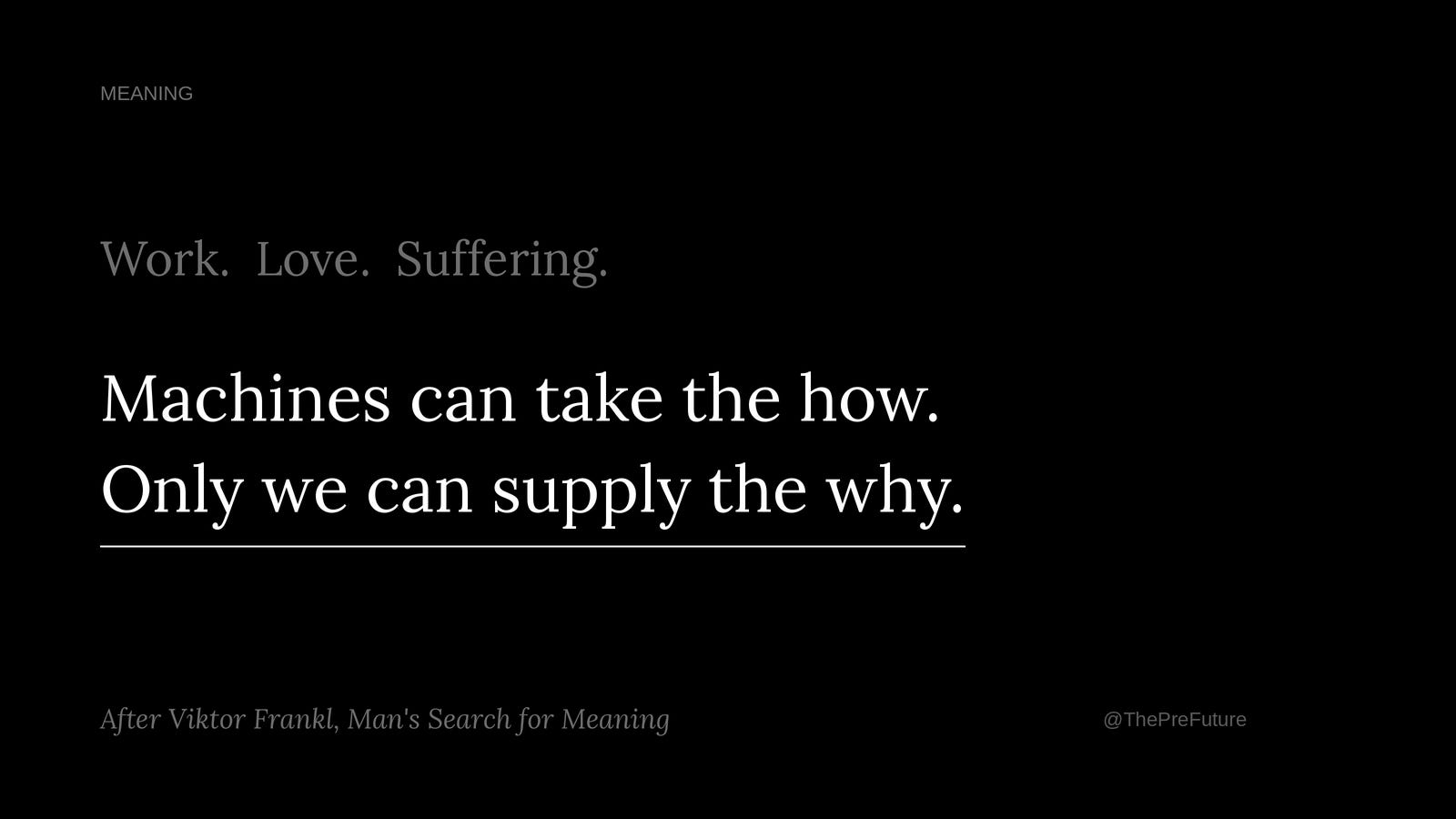
Machines can take the how. Only we can supply the why.
A question for you: if you never had to work again, what would you do with Monday? Leave a comment.
Further reading
"Man's Search for Meaning" by Viktor Frankl. A short book, written in days, that has outlived almost everything published in 1946.
"Economic Possibilities for our Grandchildren" by John Maynard Keynes. A twelve-page essay from 1930 that reads like a forecast of the AI age.
Sources