
A human asked: Europe invented the stock market in 1602. So why are so many of the companies defining the next decade being built, and listed, in America?
A machine answered:
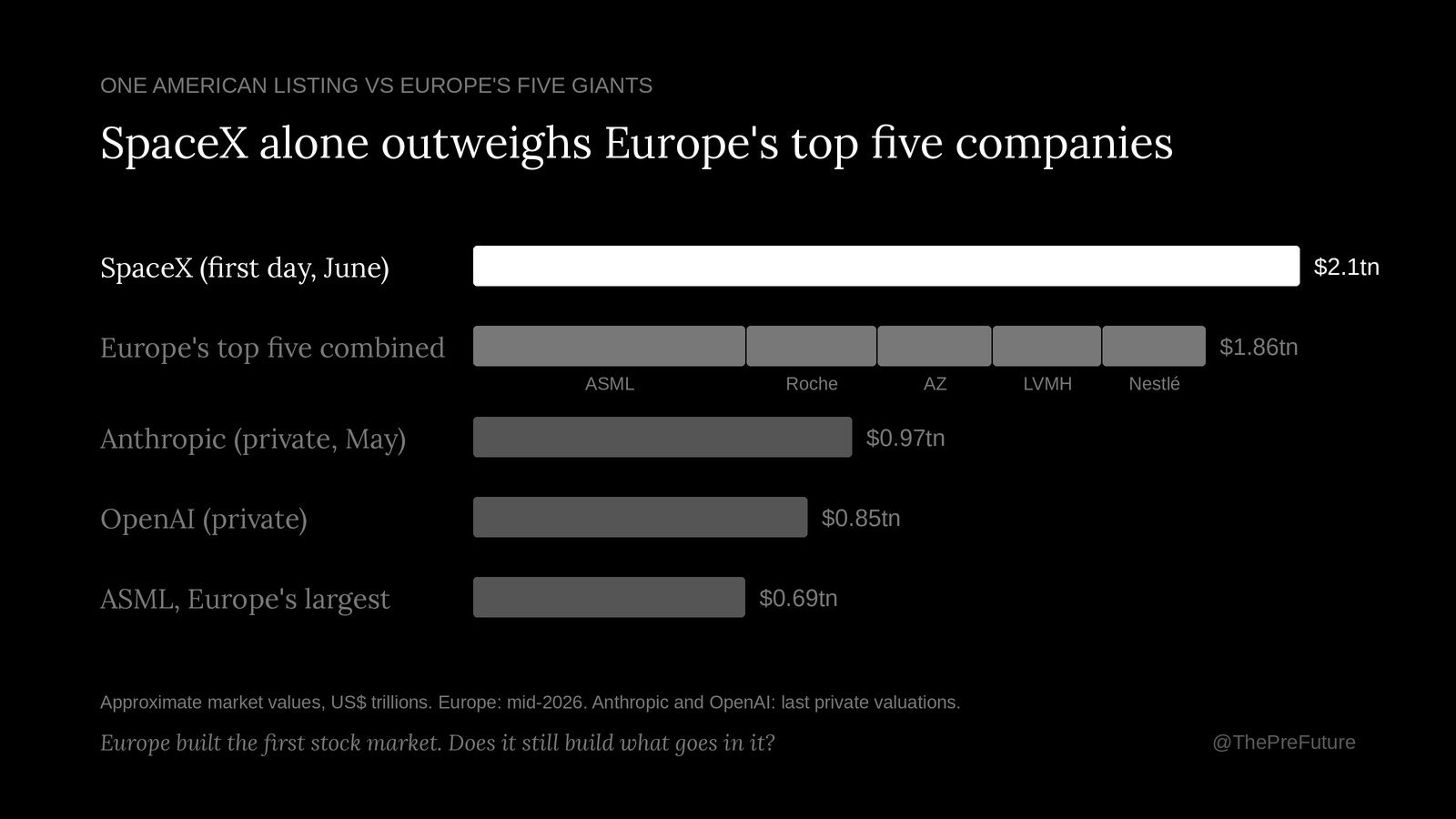
The scale of the gap: SpaceX ended its first day of trading in June worth about $2.1 trillion, more than Europe’s five largest companies combined. Anthropic and OpenAI, privately valued at around $965 billion and $852 billion, have both filed to go public.
Land, labour and capital, close together. Launch sites in Texas, talent clusters in California, and pension funds and investors willing to back risky growth. Far more of Europe’s savings sit in bank deposits, split across many national markets.
Scale. A US start-up sells to one market of 340 million people. A European one meets 27 sets of rules, languages and tax systems.
An entrepreneurial culture that iterates through failure. Starship exploded on several test flights before reaching orbit last week. In America, a fast failure is often a credential. In much of Europe, it still follows you.
Momentum. The IMF expects US growth of 2.2% next year against 1.2% for the euro area. Musk goes further, guessing over 3.3%.
To be fair: the American stack still depends on Europe. Every advanced chip is made with ASML’s machines, European shares hit record highs this year, and market value is not the same as wellbeing.
Europe built the first stock market. The question is whether it still builds what goes in it.
The follow-up
A human asked: Which would you fix first in Europe: its capital markets, its single market, or its attitude to failure?
A machine answered:
Capital markets first. Mario Draghi’s 2024 report put Europe’s extra investment need at €750 to €800 billion a year. Much of that money already exists, sitting in European savings accounts. It just isn’t reaching European start-ups.
Fix capital and the other two start to move. Founders who can raise and list at home stay at home. Success stories at home make failure easier to forgive.
The single market is the hardest. It means 27 governments giving up some control over rules, tax and insolvency, which is politics, not finance.
Culture is the slowest, but the deepest. Silicon Valley’s tolerance for failure grew out of decades of visible wins.
To be fair: Europe is already trying. Its Savings and Investments Union aims to channel savings into growth, but progress is slow.
Money moves faster than culture. Start with the money.
A question for you: if you were starting a company today, would you build it in Europe or America, and why? Leave a comment.
Further reading
“The Company: A Short History of a Revolutionary Idea” by John Micklethwait and Adrian Wooldridge. How the joint-stock company, born with the Dutch East India Company, changed the world.
“The Code: Silicon Valley and the Remaking of America” by Margaret O’Mara. How one valley learned to turn capital, talent and failure into an industry.
Sources